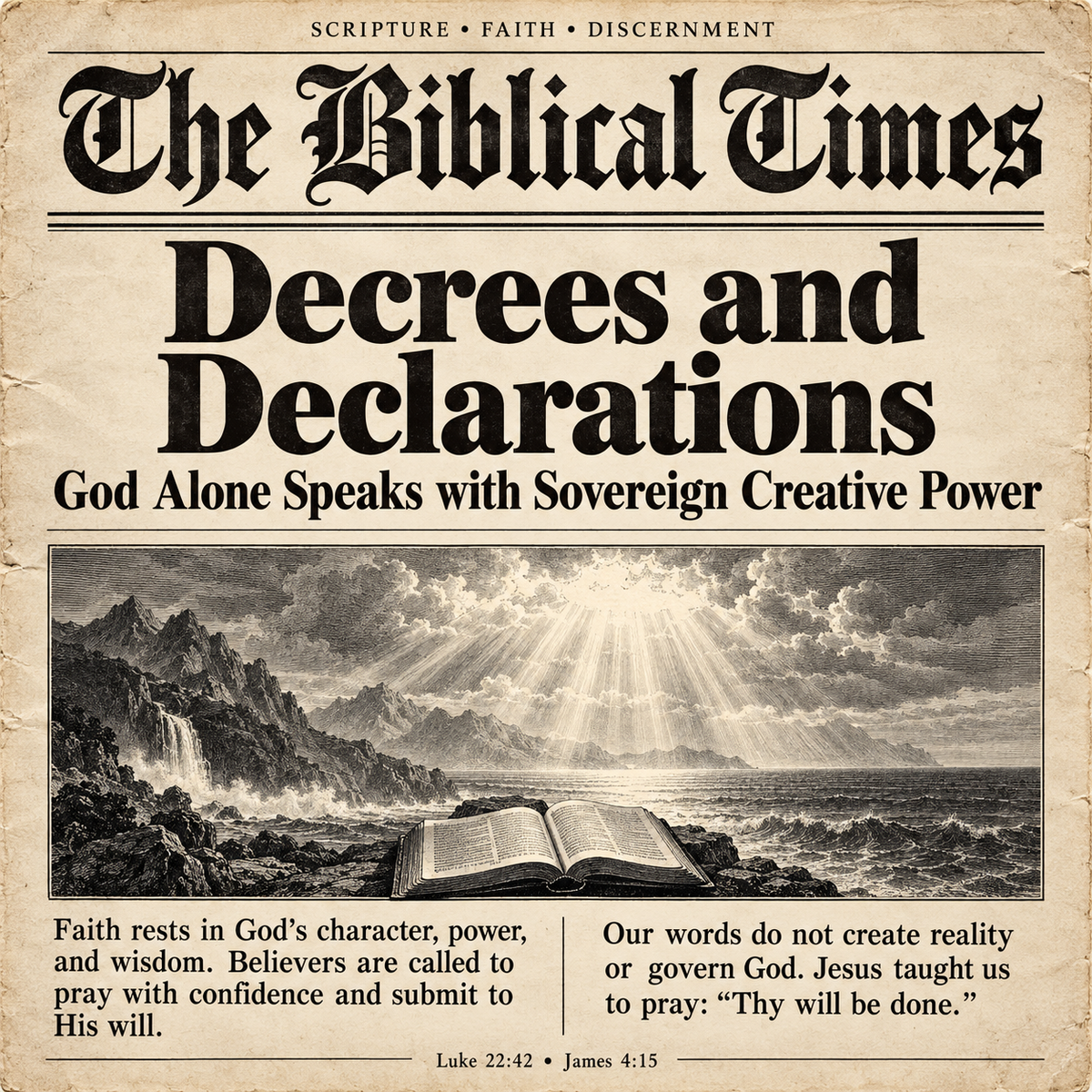
Decrees and Declarations

Randal W. Deese, October, 21, 2026
Decrees and Declarations: A Position Paper of Biblical Pentecostals.
We believe Scripture does not teach that believers possess the power to decree or declare realities into existence.
The Bible does not teach that people have sovereign power to create new realities, determine future events, control circumstances, or bring about desired outcomes simply by speaking a “decree and declaration” formula. Sovereign, creative speech belongs uniquely to God. His Word accomplishes His will because He alone is the Creator, Lord, and King over all things.
God Alone Speaks with Sovereign Creative Power
Scripture begins by presenting God as the One whose Word brings creation into existence: “Then God said, ‘Let there be light’; and there was light” (Gen. 1:3). The heavens were made by the Word of the Lord, and all creation exists because He commanded it (Ps. 33:6–9). God declares “the end from the beginning” and accomplishes His purpose because no one can thwart His sovereign will (Isa. 46:9–11).Paul likewise identifies God—not believers—as the One “who gives life to the dead and calls into existence the things that do not exist” (Rom. 4:17). This passage does not teach that Abraham created his promised future by speaking it into existence. Abraham trusted the God who had sovereignly promised what only God could accomplish.
Biblical faith does not imitate God’s sovereignty; it relies on it
God’s Word accomplishes what He sends it to accomplish because it proceeds from His own omnipotent will:So shall My word be that goes forth from My mouth; It shall not return to Me void, But it shall accomplish what I please (Isa. 55:11).No comparable promise applies to every desire, prediction, declaration, or command a believer speaks.
Believers Proclaim God’s Word; They Do Not Create Reality
Christians are commanded to proclaim, confess, teach, testify, bless, encourage, warn, and speak the truth. These are powerful and necessary forms of biblical speech. Believers declare “the praises of Him who called” them out of darkness (1 Pet. 2:9), confess Jesus as Lord (Rom. 10:9), proclaim the gospel (Mark 16:15), and speak God’s truth boldly (Acts 4:29–31).
Such a declaration announces what God has revealed or accomplished. It does not create truth, guarantee a preferred outcome, or independently control future events. The authority of Christian proclamation rests entirely in the truth and authority of the message God has given—not in the believer’s vocal intensity, confidence, wording, confession, or use of a particular formula.
The prophets did not speak whatever they personally desired and then expect God to make it happen. They were required to speak only the Word God placed in their mouths:
Whatever I command you, you shall speak (Jer. 1:7).
Ezekiel was similarly instructed,
You shall speak My words to them (Ezek. 2:7).
Jesus also declared that He did not speak independently but spoke according to the Father’s commandment (John 12:49–50), which is the key to authentic biblical faith. Therefore, no believer should claim greater independence in their spoken word than the prophets, apostles, or the Lord Jesus Himself demonstrated.
Prayer Is Petition, Not Sovereign Command
Jesus taught His disciples to pray,
Your kingdom come. Your will be done on earth as it is in heaven (Matt. 6:10).
Biblical prayer approaches God with confidence, but it does not replace God’s will with human sovereignty.
The apostles didn’t behave as if their own confession determined reality, nor should modern believers. When threatened, they prayed to the “Sovereign Lord” for boldness and for signs performed by His power (Acts 4:24–30). When Peter was imprisoned, the Church offered “constant prayer” to God for him (Acts 12:5). They did not treat prayer as a verbal mechanism that automatically produced their preferred outcome. That idea is a modern invention.
Scripture teaches believers to ask in faith while remaining submitted to God’s wisdom and will:
Now this is the confidence that we have in Him, that if we ask anything according to His will, He hears us (1 John 5:14).
In fact, James warns against presuming to speak about the future. Rather than declaring that a particular plan must happen, believers should say,
If the Lord wills, we shall live and do this or that (James 4:13–16).
Submission to the Lord’s will is not unbelief; it is faith that trusts both His power and His wisdom. Biblical faith confidently asks God to act without presuming to dictate His answer. Jesus Himself, who had perfect faith, prayed,
Nevertheless, not my will, but thine, be done (Luke 22:42).
This demonstrates that earnest prayer and complete surrender belong together. Likewise, “if the Lord will” expresses faithful dependence, not doubt (James 4:15). Authentic faith rests in God’s character, embraces His promises, and entrusts the outcome to Him: He is sovereign, and we are not.
Faith Does Not Mean Faith in Our Own Words
Jesus’ teaching about speaking to a mountain must be interpreted within its own context:
Have faith in God (Mark 11:22).
The emphasis is on faith in God—trusting His character, power, and wisdom—not on the believer’s ability to speak realities into existence; in reality, it is “faith in faith,” making confidence in one’s word, confession, or decree itself the source of power.
Our words do not govern God or guarantee outcomes; authentic faith brings its requests to Him and submits to His will. Jesus immediately connects having faith in God (not our confession) with this promise:
Whatever things you ask when you pray, believe that you receive them (Mark 11:24).
Contextually, notice how He also links believing prayer to forgiveness and to a heart rightly ordered before God (Mark 11:25).
This text teaches nowhere that faith is confidence in the creative power of our words. Faith is confidence in God's character, promise, wisdom, and power. The believer does not control God with his words; the believer trusts God in prayer.
Likewise, Jesus’ promises about asking in His name do not authorize using His name as a magical formula to force a desired outcome. It is not a pagan incantation that guarantees what is desired. Asking in Jesus’ name means asking as one who abides in Him, represents His interests, seeks His glory, and submits to His will (John 14:13–14; 15:7; 16:23–24).
The Tongue Has Great Power, but Not Divine Omnipotence
The book of Proverbs states that
death and life are in the power of the tongue (Prov. 18:21).
This teaches that words carry profound moral, relational, emotional, and practical consequences. They can deceive, destroy reputations, provoke violence, crush spirits, convey wisdom, reconcile enemies, encourage the discouraged, and proclaim the message of salvation.
However, this verse does not teach that human speech has God’s creative power or that every spoken word becomes reality. Many theological problems result from taking a passage out of its context. Proverbs' broader teaching concerns the consequences of wise and foolish speech, not the metaphysical creation of circumstances through verbal declaration (Prov. 12:18; 15:1–4; 16:24; 18:6–8).
James likewise describes the tongue as powerful because it can produce immense good or harm through human relationships and conduct (James 3:2–12). Neither Proverbs nor James teaches that words function as spiritual laws compelling the universe to conform to human desires.
The Passage Job 22:28 Does Not Establish a Christian Practice of Decreeing
The statement,
Yo will also declare a thing, and it will be established for you (Job 22:28)
is often cited to defend the practice of decreeing desired outcomes. However, Eliphaz, one of Job’s counselors, spoke these words. God did not consider him a very good counselor, yet many modern Christians do. At the end of the book, God rebuked Eliphaz and his companions for not speaking rightly about Him (Job 42:7–8).
A statement from a rebuked counselor cannot be removed from its literary context and treated as a universal promise that believers may decree circumstances into existence. This is another example of how taking a passage out of context creates theological problems. Sound doctrine must be grounded in Scripture's clear, consistent teaching, not in isolated statements from people whose theology the biblical narrative corrects.
Delegated Authority Remains Subject to Christ
Jesus gave His disciples genuine authority to preach the gospel, make disciples, exercise church discipline, resist the devil, cast out demons, and minister in His name (Matt. 10:1; 16:19; 18:18; 28:18–20; Luke 10:17–20; John 20:21–23; James 4:7). Yet delegated authority is never autonomous sovereignty.
The apostles exercised authority as servants commissioned by Christ. Their power came from, was limited by, and was governed by the Lord who sent them. They did not teach that every Christian could determine the future, command wealth, eliminate all suffering, or guarantee healing by verbal decree.
Paul could not simply decree that his “thorn in the flesh” disappear. He pleaded with the Lord three times, and the Lord answered according to His greater purpose: “My grace is sufficient for you” (2 Cor. 12:7–9). Paul left Trophimus sick at Miletus (2 Tim. 4:20), advised Timothy about recurring illness (1 Tim. 5:23), and thanked God for showing mercy to the seriously ill Epaphroditus (Phil. 2:25–27). These examples demonstrate faith, prayer, compassion, and dependence on God—not sovereign control of circumstances through declarations. Some modern believers appear to believe they have more power in their lives than the apostle Paul.
Our Position
Therefore, Biblical Pentecostals reject the teaching that believers possess inherent or delegated sovereignty to create reality, determine future events, guarantee healing or prosperity, cancel every hardship, or force spiritual and material outcomes through spoken decrees, confessions, and declarations.
We reject the idea that words function as impersonal spiritual laws that believers can use to compel God, control the universe, or activate blessings through a prescribed formula. Such teaching conflates God’s sovereign power to create by His words with human confession, turns prayer into a command, and risks placing faith in words or techniques rather than in God.
At the same time, we affirm that believers should:
- Proclaim the promises and truth of Scripture with boldness.
- Confess Jesus Christ as Lord.
- Pray with faith, perseverance, and expectancy.
- Resist the devil in submission to God.
- Exercise spiritual gifts according to the Spirit’s will.
- Speak words that bless, heal, encourage, correct, and edify.
- Ask God for healing, provision, deliverance, and intervention.
- Trust God to answer according to His wisdom, goodness, timing, and sovereign purpose.
Biblical Pentecostal faith is neither passive nor unbelieving. We pray fervently, expect God to act, welcome the gifts and power of the Holy Spirit, and boldly proclaim what God has revealed.
Nevertheless, we recognize that power belongs to God, not to our formulas. To God be the glory.